


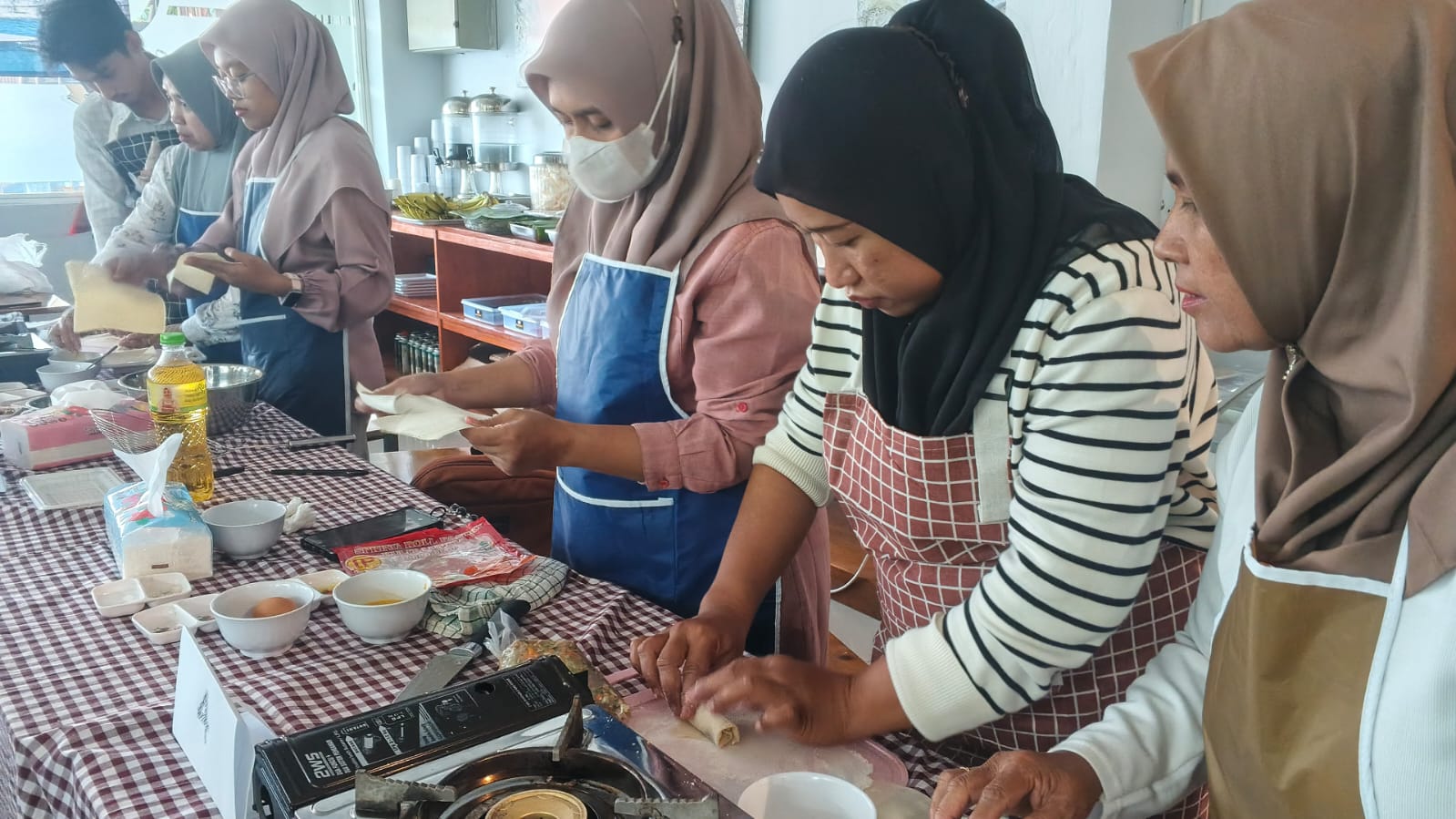
FIKKIA NEWS – Efforts to increase the added value of shrimp commodities continue through education and community empowerment. The Aquaculture Community Service Team of the Faculty of Health, Medicine, and Natural Sciences (FIKKIA) Airlangga University held a training titled "Empowering Members of the Mibama Karangrejo Cooperative and the Shrimp Farming Community through Fresh Shrimp Products in Banyuwangi." This activity was attended by cooperative members, culinary entrepreneurs, shrimp farm managers, and shrimp farmer families residing around Banyuwangi City. A total of 25 participants enthusiastically participated in the activity held on Sunday (07/06/2026) at East Village Shabu Shabu & Grill.
The training aims to improve community skills in processing shrimp into economically valuable products. Furthermore, this activity is expected to expand shrimp consumption in the domestic market and reduce dependence on export markets.

Representative Nahdlatul Ulama Banyuwangi Fishermen's UnionSholeh appreciated the collaboration involving various elements of the coastal community. He noted that the training presented different materials from similar activities previously held.
"Thank you for entrusting and empowering the Banyuwangi maritime region, along with various parties. This training has a unique approach and is very beneficial for the community," he said.
Introducing Shrimp Products to the Community
The head of the community service team, Arif Habib Fasya, S.Pi., MP, explained that Banyuwangi's shrimp farming sector has faced various challenges in recent years. Global trade issues and market fluctuations have put pressure on shrimp prices.
As a result, much of the shrimp's production must be absorbed by the domestic market. However, consumption of processed shrimp products remains relatively limited.
"We want to introduce various shrimp dishes that are easy to make and widely accepted. We hope this will encourage the domestic market to absorb more shrimp products, reducing its reliance on foreign markets," he explained.
In line with this, the Manager of the Mibama Karangrejo Cooperative, Toyib, hopes that the training will be able to produce innovative household products made from shrimp.
According to him, product diversification not only increases the economic value of shrimp commodities, but also supports the fulfillment of family nutrition, especially for children.
Learn Directly from Professional Chefs
The practical cooking session was one of the most engaging activities for the participants. Chef Irwan Murdiyanto guided participants in preparing fresh shrimp into a variety of modern dishes with the potential to be developed into business products.
Participants were divided into five groups and received cooking equipment, including knives, cutting boards, and fresh shrimp. Before beginning the practice, Chef Irwan demonstrated safe and effective knife-holding techniques.
Next, participants practiced making several menus, namely shrimp ring cheese, ebi furai, spring roll or shrimp spring rolls, as well as shrimp tempura.

In the session, Chef Irwan emphasized that shrimp meat has a natural savory taste so it does not require excessive additional seasoning.
"Use just enough seasoning to retain the authentic shrimp flavor. Flour is also used sparingly to maintain the texture and shape of the product," he explained.
He also shared the basic techniques for making tempura and ebi furai, including the batter composition and the correct flour coating steps.
Come up with new business ideas
The training received a positive response from participants. Aini, a Karangrejo resident and member of Group 5, said she gained a lot of new inspiration to develop her business.
"After attending this training, I gained new ideas for shrimp dishes. The resource person was also very good and easy to understand. I hope there will be further training in the future," he said.

Through this activity, FIKKIA UNAIR hopes that the coastal communities of Banyuwangi will be increasingly able to develop innovative, high-value, and market-acceptable shrimp products. This initiative is expected to support community welfare and boost domestic consumption of fishery products.
Author: Avicenna C. Nisa
Editor: Tasya Ramadhan


