


FIKKIA NEWS – Veterinary Medicine FIKKIA UNAIR presenting a breakthrough in the development of goat farming reproduction. Exploration of Electric Sperm Separating (ESS), a sperm sexing technology as a solution to increase livestock production and reproduction. Drh. Amung Logam Saputro, M.Si introduced ESS to 25 goat farmers from the Sambirejo community on Friday (10/010/2025) at the Seneporejo Village Hall Hall, Bangorejo, Banyuwangi. The community service aimed to introduce ESS while also broadening the farmers' horizons towards innovations that can be applied in everyday practice.
The activity was officially opened by Head of Seneporejo Village, Markus Adianto, A.Md. Hut, expressed his high appreciation for the academic initiative UNAIRIn his remarks, Markus emphasized the importance of implementing knowledge from universities in rural communities, particularly in the field of animal husbandry, which is a source of livelihood.
"We warmly welcome this initiative. The presence of our fellow students and lecturers brings new hope to our livestock farmers, enabling them to become more technologically advanced and independent," said Markus.
Sperm Sexing Education and Livestock Health Management
The educational session began with a presentation by Dr. Robi Gian Ferrari Anwar, who discussed sperm sexing technology in detail. He explained that the method Electric Sperm Separator (ESS) works on the principle of separating sperm based on the different electrical charges between the X and Y chromosomes. With this technology, breeders can determine the sex of goats from the artificial insemination stage.
"ESS technology allows farmers to more effectively manage their livestock populations. For example, if they want to increase milk production, female calves are prioritized. Conversely, for fattening, males are more profitable," Robi explained.
In addition, he also provided material on livestock health management, including pen sanitation, prevention of infectious diseases, and providing feed that is appropriate to the livestock's reproductive phase.
Next, Drh. Amung Logam Saputro provided technical guidance on the working principles of the ESS device and how this technology can be integrated into smallholder livestock systems.
"We want farmers to understand that this technology isn't complicated. With the right understanding, they can become key players in increasing superior livestock production," said Amung.
As part of the series of activities, the committee held pre- and post-test sessions to gauge participants' understanding of the material presented. Farmers with the most correct answers received prizes of one sack of concentrate and three bottles of EM4 as a token of appreciation.
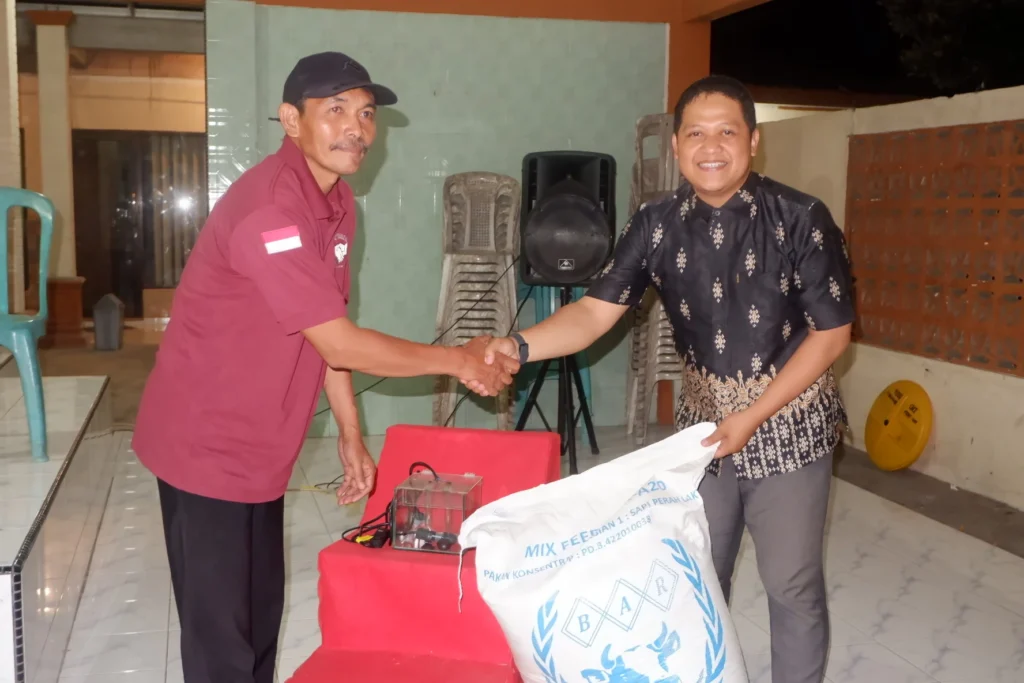
Muhammad Wahid, a member of the livestock group, achieved the highest score. He expressed his gratitude and enthusiasm for the knowledge he gained.
"I'm very happy to receive this prize. But more importantly, I've gained incredible knowledge about goat reproduction. It's opened my eyes to more modern and planned farming methods," said Wahid.
Community service is a tangible demonstration of the synergy between academia and the community in fostering technology-based innovation. With an understanding of sperm sexing and reproductive management, farmers are expected to be able to increase livestock productivity sustainably and independently.
Author: Amalia Sofi Ramadanti
Editor: Avicenna C. Nisa


