



FIKKIA NEWS – Amidst the ever-growing marine tourism boom at Pulau Merah Beach, the estuary area along the Pesanggaran coastline harbors ecological dynamics that require ongoing monitoring. To address this need, 65 second-semester FIKKIA Aquaculture students took to the field for a practical activity in the estuary area of Pulau Merah Beach, Banyuwangi, on Saturday (May 9, 2026). Beyond simply fulfilling an academic agenda, this activity served as part of a scientific effort to update data on aquatic environmental conditions while also emphasizing the role of universities in maintaining the sustainability of coastal ecosystems.
Observation Methodology
The lab's technical details were designed to obtain an accurate portrait of the ecosystem. Students were divided into groups, with each group responsible for one main observation station, which included five sub-stations. To ensure data validity, sampling was repeated at each sub-station twice.
Observations began with the installation of transect equipment to detect the presence of organisms and benthic biota buried or crawling on the waterbed at each substation. Current velocity was measured using the current ball method, followed by temperature measurements with a thermometer and salinity measurements using a refractometer to map freshwater and seawater stratification.
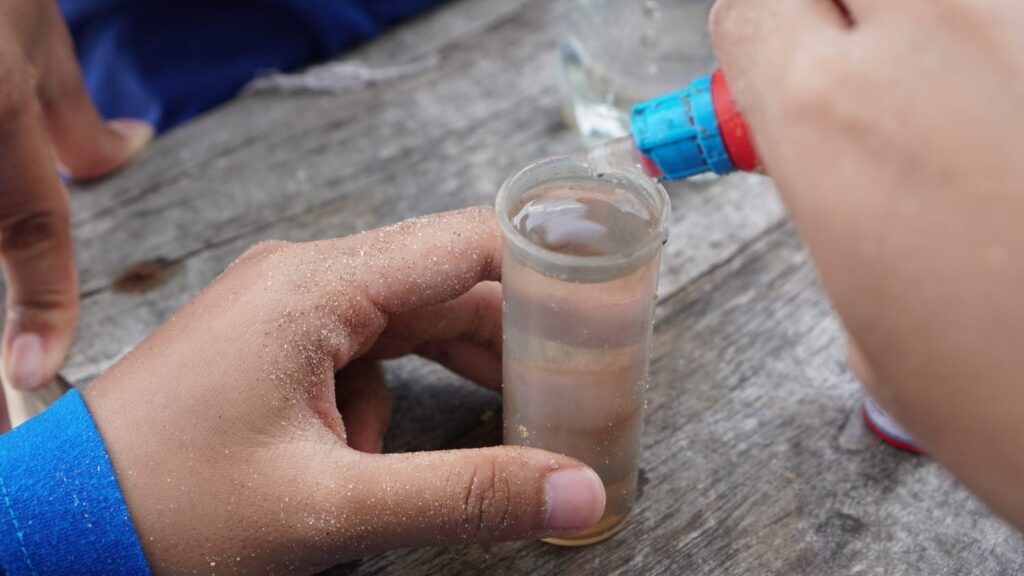
Ecological parameters examined include nitrate, nitrite, ammonia, phosphate, and dissolved oxygen levels. This data serves as a vital indicator for determining whether the environment remains healthy or is beginning to decline.
Mangrove Biota Discovery and Conservation
Based on field observations, it was found that the estuary ecosystem of Pulau Merah is still well-maintained. This is evidenced by the abundance of benthos from the bivalves and mollusks. Students successfully identified organisms from the genus Anadara sp. (blood cockles) and Donax sp., which are distributed throughout the sampling area. The presence of mangroves has also been shown to be effective in restoring coastal ecosystems, increasing biodiversity, and supporting local ecotourism potential.

The lecturer in charge of the activity, Alin Asyabil, S.Pi., MP, emphasized the importance of student involvement in this activity. He emphasized that the field data collected by students is a real contribution to science.
"I want students to be able to analyze the relationship between environmental parameters and the sustainability of these biota, especially with the support of protection from the mangrove ecosystem being restored," explained Alin.
Current Condition of the Red Island Estuary
Exploration in the Pulau Merah estuary area has very high strategic value. The estuary is a buffer zone (buffer) which is very sensitive to climate change and human activities on land.
"We sent students to the Pulau Merah estuary with the primary goal of regularly updating ecological data on the ground. We need to know the current condition of the biota and water quality, and whether there have been any significant changes due to tourism activities or other natural factors," Alin emphasized.
He also added that the results of this practicum will later be processed into a scientific report which is expected to be a reference for coastal management in Banyuwangi.
Through the synergy between field observation and scientific analysis, Aquaculture students demonstrate that learning isn't confined to the classroom. Awareness of continuously monitoring and preserving natural conditions, as demonstrated on Pulau Merah, is a key foundation for the future advancement of the sustainable aquaculture industry.
Author: Farra Azzahrani
Editor: Avicenna C. Nisa


