


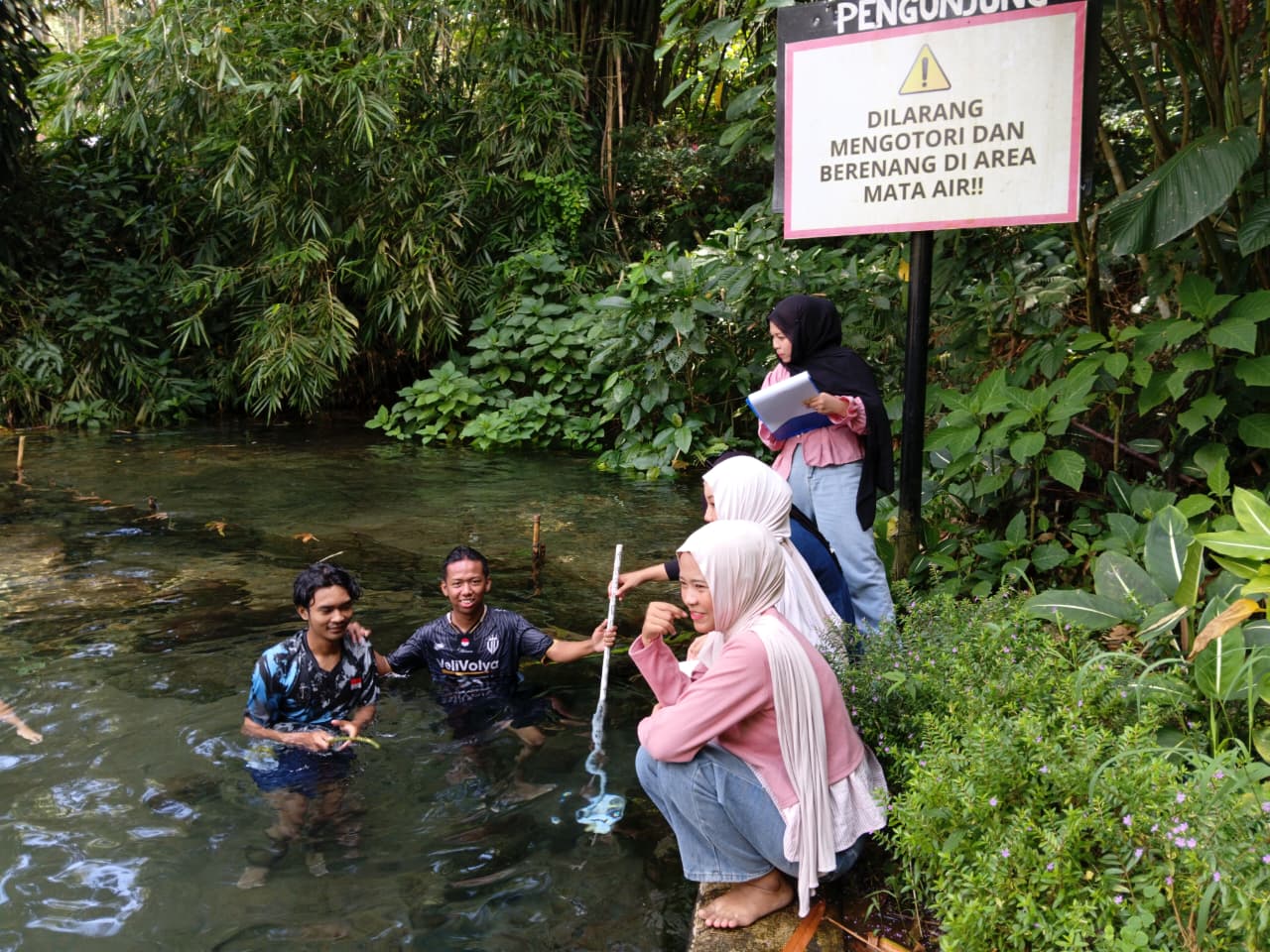
FIKKIA NEWS – The Aquaculture Study Program of the Faculty of Health, Medicine, and Natural Sciences (FIKKIA) at Airlangga University once again held a field practicum as a form of ecosystem-based learning. This time, students were invited to examine the complexities of the freshwater ecosystem at Sendang Seruni, a water conservation-based tourist destination in Banyuwangi, on Saturday and Sunday (April 4-5, 2026).
This Aquatic Ecology course practicum focuses on identifying organisms and biota, as well as mapping the environmental quality that supports life in freshwater. This field practicum will take place not only at Sendang Seruni but also at other tourist attractions, such as Goa Sodong, Banyu Kuwung, Sendang Jopura, and Sumber Darmo.
Field Sampling and Exploration Methods
The first day's agenda began with an introduction to the terrain and exploration area. Students took fish samples using fish traps to observe the biodiversity living in the spring. The traps were installed at various strategic points in the spring to represent the spatial distribution of biota.

The installation, which began on the first day, aimed to allow time for aquatic biota, both fish and crustaceans, to be caught naturally before identification the following day. Students also conducted environmental observations to understand the physical characteristics of Sendang Seruni, known for its abundant and clear spring water.
Water Quality Analysis and Biota Identification
Entering the second day, the focus shifted to quantitative and qualitative data collection. Students checked water quality parameters, including pH, dissolved oxygen (DO), nitrate, nitrite, ammonia, and phosphate. This chemical parameter data is key to analyzing the correlation between environmental conditions and population abundance levels and the dominance index of certain species.

This is crucial for assessing the health of the Sendang Seruni ecosystem. Considering that the location also serves as a tourist attraction, it could potentially put ecological pressure on the native biota. Students are required to be skilled in using field equipment to ensure the accuracy of the data collected.
Maintaining Etiquette in the Sacred Area of Sendang Seruni
Beyond its natural beauty, Sendang Seruni is a highly revered area among the local community for its historical and spiritual significance. Endang, the caretaker, advised students to uphold ethics and manners.
"For us, water is a source of life and its purity must be maintained. Therefore, I always advise my fellow students to be mindful of their behavior and speech while conducting research. Maintaining good manners in nature is part of preserving it," said Endang.
Data Integrity and Field Sensitivity
At the end of the activity, the lab assistant provided evaluative notes as well as motivation for the practicum participants to continue to hone their sensitivity to natural phenomena.
"Field practicum is a true laboratory. I hope my students will truly hone their analytical instincts for natural phenomena," said practicum assistant Fahmi (AKUA 22).
Understanding the exploration area is essential to ensure the ecosystem remains balanced amidst the hustle and bustle of human activity around Sendang Seruni. Just as nature gives, so do humans care.
Author: Farra Azzahrani
Editor: Avicenna C. Nisa


