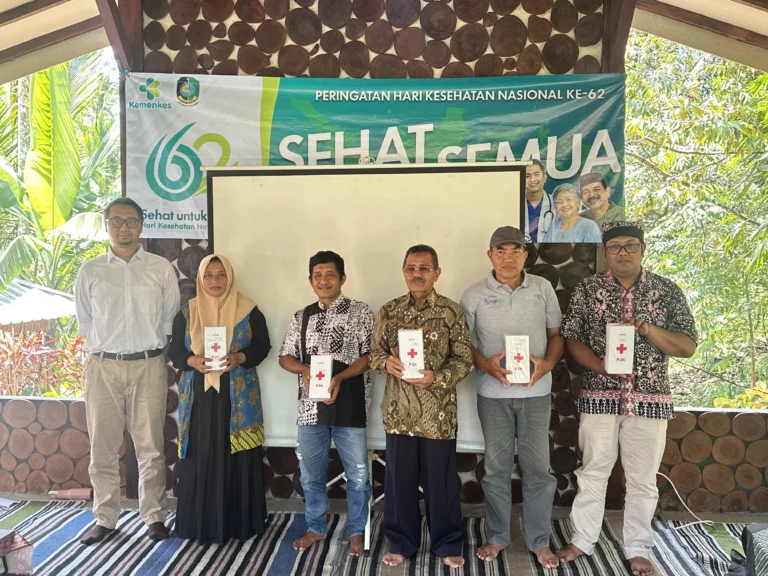



FIKKIA NEWS – Subclinical mastitis is a specter that haunts dairy goat farmers. The disease that attacks the mammary glands can reduce milk production, as well as cause extraordinary pain in the udders of livestock. To prevent this from happening, Veterinary Medicine Study Program FIKKIA UNAIR held early detection training for subclinical mastitis. The training was attended by 15 dairy goat farmers from Telemung Village, Kalipuro, Banyuwangi, Friday (09/05/2025) in UD Karya Etawa Farm. Subclinical mastitis is a type of mastitis that does not show clinical symptoms.
The training aims to improve the knowledge and skills of farmers in detecting subclinical mastitis using the California Mastitis Test (CMT), in order to maintain livestock health and increase goat milk production.

Kalipuro was chosen as the training location because it is one of the five sub-districts with the largest goat population in Banyuwangi. Based on the 2020 Banyuwangi Central Statistics Agency census, there are around 14.000 goats and sheep. Telemung Village, which is located in Kalipuro, even has a population of around 6.000 dairy goats. The goat farms there produce an average of 2000 liters of milk per day. Making Telemung Village have this great potential makes Kalipuro a priority area in the development of dairy goat farming.
Early Detection Training for Subclinical Mastitis
The chairman of the committee, Faisal Fikri, drh., M.Vet., explained that this program is part of the Tri Dharma of Higher Education, especially community service. "Through this training, we want farmers to be able to recognize subclinical mastitis early so that they can carry out appropriate prevention and treatment," he said.
As a speaker, Prima Ayu Wibawati, drh., M.Si., explained that subclinical mastitis is inflammation of the udder that does not cause obvious symptoms so it is difficult to detect without special examination.
"CMT is an easy, economical and effective method to detect subclinical mastitis in dairy goats. If the udder is already inflamed, this test is not necessary because clinical mastitis can be recognized by the naked eye," he explained.

The training was conducted interactively. It began with a pretest to measure participants' knowledge, then continued with material presentation and conducting CMT tests in the barn. Participants were taught the correct milk sampling technique and how to read the test results.
Arya Agung, one of the participants, admitted that the training was very useful. "I understand more about how to detect subclinical mastitis. After this training, I am more confident in caring for goats so that they remain healthy and produce optimal milk," he said.
This activity is expected to increase the awareness and ability of farmers in maintaining livestock health through early detection of disease, while strengthening Kalipuro's position as a dairy goat center in Banyuwangi.
The activities in this article are the implementation of SDGs values point 15. Life on Land, and 17st Partnerships for the Goals
Author: Princess Ajeng Aprisa Simorangkir
Editor: Avicenna C. Nisa