


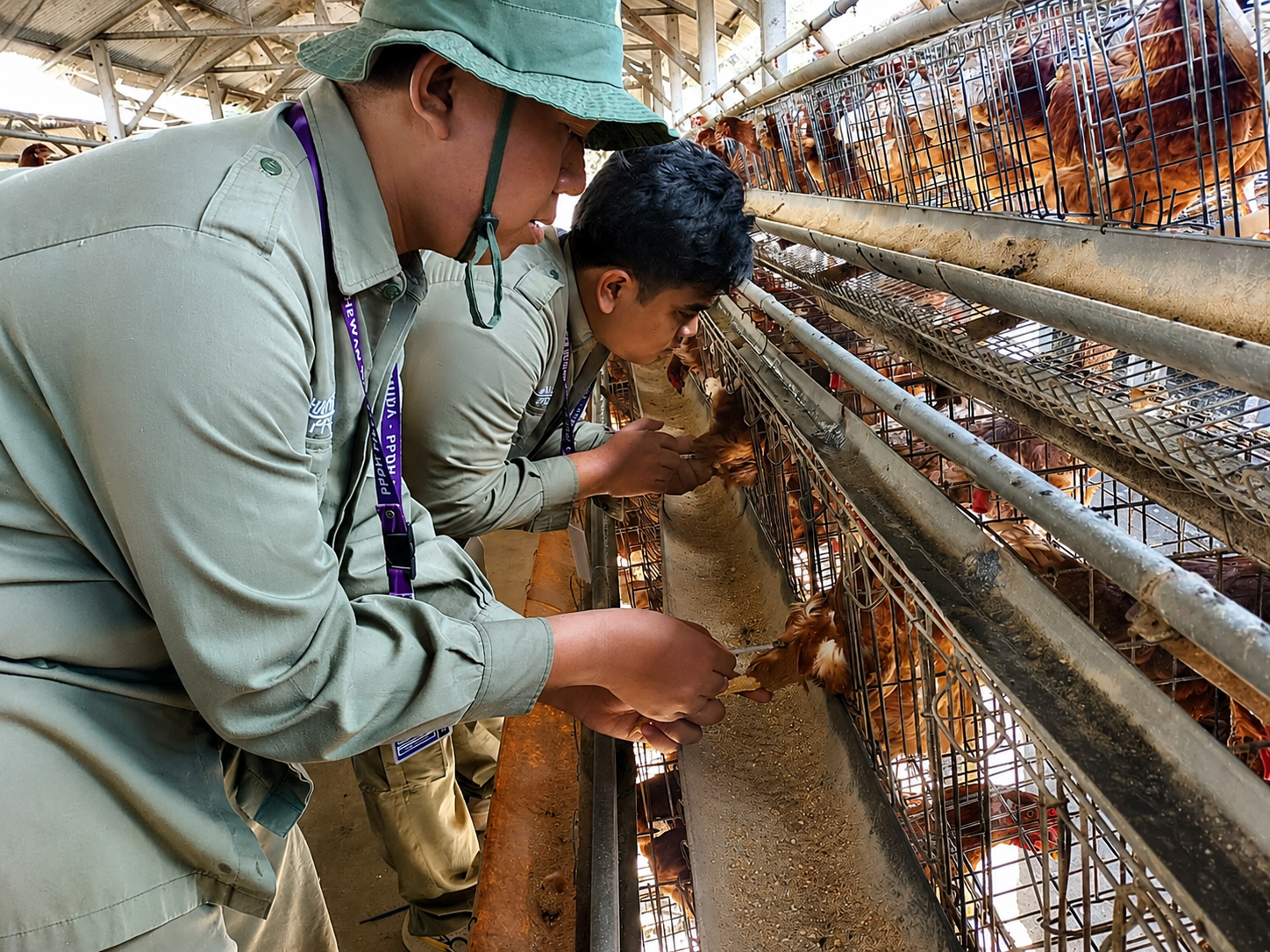
FIKKIA NEWS – The poultry industry demands veterinarians with comprehensive clinical, production management, and health skills. Through the Poultry Health Internship (PKL) at UD Central Unggas Jaya Farm in Talun, Blitar Regency, students of the Veterinary Professional Education (PPDH) program at the Faculty of Health, Medicine, and Natural Sciences (FIKKIA) at Airlangga University gained hands-on experience in production management and the health of laying hens.
The students were from Group 1 of Wave III of the FIKKIA PPDH program, which took place from Monday (July 6, 2026) to Friday (June 24, 2026). The group consisted of Alfian Dzaka Fadhil Ramadhan, Azhar Burhanuddin, and Muhammad Alivio Putra Fajar.
Phase Management Starter, grower, and Layer
Phase starter started since chick in from the period of 0 to 8 weeks. This stage is a very decisive period for the success of maintenance because of organ growth,
Immune system development and skeletal formation occur very rapidly. Optimal cage preparation must be carried out before the DOCs arrive.
Owner of UD Central Unggas Farm, drh. Tri Widodo, said that before the chickens enter, there are cleaning activities, disinfection of the cage, and installation of a cage. litter The brooding temperature should be around 35-36°C, and adequate, clean water should be provided immediately, with a volume twice the feed volume. Feed should be provided as frequently as possible, and ventilation and lighting should be maintained as needed.
"Area expansion or population relocation can be done by considering the density of chickens in one cage," he explained.
The grower phase layer chicken coop at UD. Central Unggas Farm, Blitar, has a capacity of 7.000 chickens, using a two-story communal system, with 10 chickens per coop, spread across six different flocks, and equipped with one quarantine coop. During the PKL, the chickens were of the grower phase. grower is at 10 weeks old.
The type of cage used is open house. Meanwhile, the layer phase chicken coop is separate from the starter and grower phase coops. The layer phase coop is stage-shaped with 18 flocks each having 2 gangway and consists of 2 levels. The height of the base with the cage is 1,5 meters.
"The higher the cage's position relative to the floor, the less likely it is to be exposed to ammonia, which can cause respiratory and reproductive health problems," he said.
Health and Disinfection Program
Health management during the layer phase is crucial for maintaining egg productivity, maintaining flock health, and minimizing economic losses due to disease. The health program focuses on maintaining immunity through follow-up vaccinations, strict biosecurity practices, parasite control, pen sanitation, and regular health monitoring. Monitoring for sick chickens is conducted in the morning, targeting individual treatment in each pen.
Biosecurity implementation is an integral part of layer health management. One measure is spraying cages with disinfectant at least twice a week. The goal is to reduce the number of pathogenic microorganisms in the cage environment, thereby minimizing the risk of disease transmission. The disinfection program is carried out routinely using effective disinfectants and applied according to procedures to avoid disrupting chicken health or production activities.
Author: Azhar Burhanuddin
Editor: Avicenna C. Nisa


