Indonesia is a country in Southeast Asia that has quite high economic fluctuations. Global uncertainty, policy pressures, and the Covid-19 pandemic that has hit the world in recent years have further fueled economic fluctuations in Indonesia. Judging from the data released by the related World Bank Gross National Income (GNI), Indonesia is one of the countries with a high intensity of GNI changes. In 2018, Indonesia had a GNI of US$ 3.840 per capita. Significantly increasing in 2019, Indonesia's GNI reached US$ 4.070. This increase even brought Indonesia up one level from Lower-Middle Income Countries/LMIC became a country with economic status Upper-Middle Income Countries/UMIC in 2019.
The status of UMIC in the Indonesian economy in 2019 did not last long. In 2020, Indonesia has again downgraded its status to a state lower-middle income country. This was due to the decline in Indonesia's GNI to US$ 3.870. The decline in GNI was inseparable from the major influence of the Covid-19 pandemic which hit and stopped almost all world economic activity.
The high fluctuation of Indonesia's GNI which affects Indonesia's economic status by the World Bank, certainly needs special attention for the Indonesian government. The World Bank has 4 categories based on the economic status of a country Gross National Income (GNI) per capita. The latest threshold rules issued by World Bank and valid from 1 July 2021 namely: Low Income (< US$ 1.045), Lower Middle Income (US$ 1.046 – US$ 4,095), Upper Middle Income (US$ 4.096 – US$ 12.695) and High Income (> US$ 12.695).
After in 2020 Indonesia experienced a decrease in GNI and lowered its status from UMIC to LMIC, until now the Indonesian economy is gradually recovering. In 2021, Indonesia's GNI will increase from US$ 3.870 (2020) to US$ 4.170 (2021). Showing improvement again in 2022, Indonesia with a GNI of US$ 4.580 has managed to return to the status of Upper-Middle Income Countries/UMIC. The World Bank records Indonesia as a country with a GNI increase of 9,8% in 2022.
Factors driving Indonesia to become an Upper-Middle Income Country/UMIC
The return of Indonesia to UMIC status by the World Bank is inseparable from the role of implementing various policies by the Government of Indonesia. Various policies were carried out by the Government of Indonesia to respond to the economic contraction since the pandemic hit. The government provides convenience in fiscal and monetary policies which are positively welcomed by the public and business actors. It is hoped that this will proceed according to the Government's plan in order to restore Indonesia's economic conditions. Another policy from the Government of Indonesia is to allocate APBN funds by increasing domestic consumption, increasing business activity and maintaining economic stability and monetary expansion. The policy aims to allow the economy to recover and Gross National Income (GNI) Indonesia can increase again.
The solution to efforts to increase Indonesia's Gross National Income (GNI).
Increase in Indonesia's GNI which has an impact on status Indonesian economy can be increased through efforts to downstream natural resources (SDA). Reporting from the official website of the Ministry of Environment and Forestry of the Republic of Indonesia, Downstream natural resources can be interpreted as an effort to increase the added value of natural resources through natural resources processing in a manufacturing industry. The phenomenon that has existed so far is that Indonesia's natural resources (SDA) are often exported as pure commodities and without added value. Later, natural resources that have been exported by Indonesia abroad are then processed into finished goods and re-imported to Indonesia with a fairly high value. Such trade flows of natural resources have prevented the value of Indonesia's exports from being boosted.
Thus, natural resource downstreaming needs to be of particular concern to the Government as one of the efforts to increase Indonesia's GNI. Downstreaming natural resources can create new economic growth centers to realize the locomotive of national economic growth. Among them are the creation of a raw material processing industry, creating product added value, creating business opportunities, encouraging investors, absorbing labor, and increasing national income.
The positive impact of Indonesia as an Upper-Middle Income Country/UMIC
The country's economic status provided by the World Bank is certainly an important benchmark for a country in terms of improving its economic condition. The UMIC status achieved by Indonesia in 2022 can be proof of economic resilience and maintained sustainable growth. This increase in economic status can strengthen the confidence of investors, trade partners, bilateral partners and development partners in the resilience of the Indonesian economy.
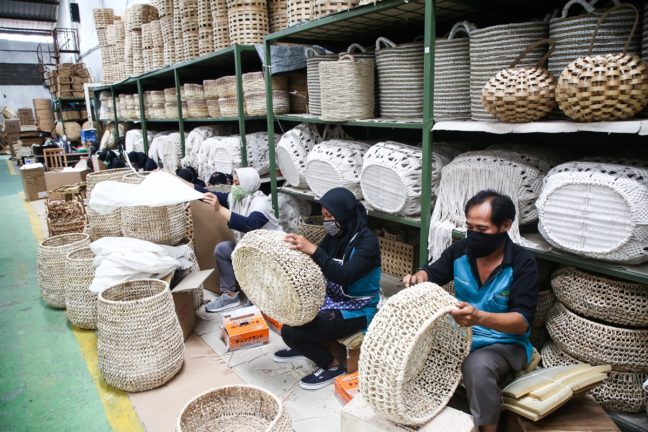
In addition, the positive impact was also felt by the people of Indonesia engaged in trade. Since the Covid-19 pandemic to post-pandemic, business actors have found it easier to obtain business credit facilities. The file requirements for the amount of interest given are also getting smaller. The government is trying to drive trade by delaying installments and subsidizing bank credit interest for MSMEs, interest subsidies through People's Business Credit and Ultra Micro, to providing working capital loans. The government also provides tax incentives to corporations such as exemption from Article 22 PPh on imports, reduction of Article 25 PPh installments, and preliminary VAT refunds. So that with the establishment of Indonesia as a UMIC country, it can provide encouragement to the Indonesian government to be more able to move the trade cycle in Indonesia to maintain the country's economy.
This economic status is also used by the World Bank as one of the factors that determines whether a country meets the requirements to use World Bank facilities and products. One example is the determination of acquisition loan pricing or loan price. Based on data released by the World Bank Group Finances, it is stated that during the period 2014 to 2022 the World Bank has provided loans to Indonesia amounting to US$ 15,67 billion. The nominal loan received by Indonesia from the World Bank is the largest nominal compared to other countries in Southeast Asia.
The large lending from the World Bank to Indonesia is proof that with the designation of Indonesia as Upper-Middle Income Countries/UMIC can increase the trust of development partners and resilience, namely the World Bank, to Indonesia. However, this must still be balanced with accelerating economic transformation through the development of sectors with high added value. In addition, it is also important to strengthen the quality of human resources, accelerate infrastructure development, and improve regulations and bureaucracy in order to create a more conducive and competitive business and investment climate for Indonesia.
Author: Ahmad Danang Sagita (K. Banyuwangi Accounting Student)
Editor : Avicenna C. Nisa