


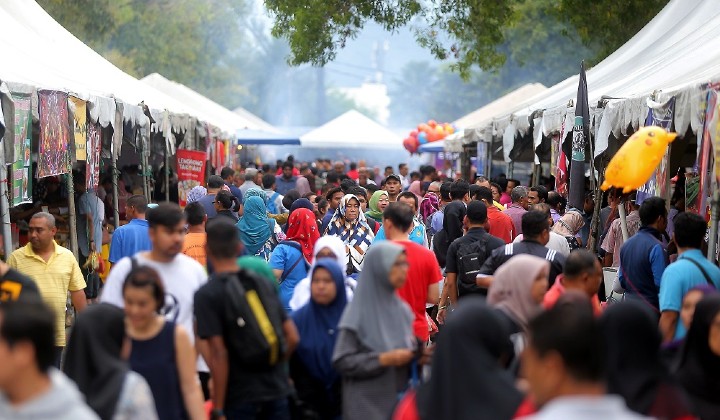
The holy month of Ramadan is the month that all Muslims in the world have been waiting for. The glory of the month of Ramadan is clearly implied in QS Al-Baqorah 185.
"Allah praises the month of Ramadan from other months because this month was chosen as the month when the Qur'an was sent down and good deeds are multiplied during the month of Ramadan."
The community also changed their lifestyle to be more special than usual. Many worship activities that increase closeness to the creator. The obligation to fast, share takjil to others, give alms to those in need, increase reading of the Qur'an, and worship at night during the month of Ramadan.
However, it seems that people's activities are starting to shift in reviving the month of Ramadan. Most people are more enthusiastic about trying various dishes typical of the fasting month. Sometimes there are those who 'crazy' in buying various items. This is particularly evident in Indonesia. The emergence of various snack bazaars and Eid fashion needs that are present in shopping centers to roadside vendors who only sell during Eid.
As is well known, in the month of Ramadan Muslims are required to fast. Fasting is done by not eating and drinking from sunrise to sunset for one month. In theory, people should be able to save expenses during Ramadan. This is because there is a reduction in the quantity of food consumed, from initially three times a day to twice a day effectively before dawn and breaking the fast.
In fact, what I encountered was inversely proportional to the theory. Community needs during the month of Ramadan actually increase due to consumptive behavior of the people who misinterpret the privileges of Ramadan. Survey results from SurveySensum show that the public has prepared an average of IDR 6,9 million for Ramadan spending in 2022. This figure is the highest figure in the last four years, in 2019 the average public spending budget for the month of Ramadan was IDR 6,8 million, in 2020 it was IDR 6,3 million, and in 2021 it will be at IDR 6,2 million.
The increase in the Indonesian people's spending budget in 2022 during Ramadan needs to be a concern, especially for students as the driving force for a higher quality life change for the community.
The increase in consumptive behavior during the month of Ramadan is influenced by several factors. In my opinion, one of the common factors is the large number of unplanned expenses and the greater desire to shop. This can happen because generally people are tempted by the many offers that come during Ramadan and there are also social factors that influence a person to be more consumptive.
The phenomenon of increasing consumptive behavior during Ramadan can be exemplified by several phenomena that occur in the field. For household consumers, consumptive behavior usually occurs in purchasing food needs that are different from usual. Where they serve food to break the fast and the meal becomes even more special as a form of appreciation for having fasted for the full day.
Not even half-hearted, there are a handful of people who schedule to break their fast in special places with relatively high prices. The results of the interview survey in the study of Analysis of Factors Influencing People's Consumption Behavior in the Month of Ramadan 2019, which stated that the increase in consumption increased due to food needs, which initially ate ordinary side dishes but because of the month of Ramadan, sahur and breaking the fast had to use side dishes as delicious as possible so that they would be more enthusiastic about fasting during Ramadan.
As for students, the phenomenon of increasing consumptive behavior during Ramadan also often occurs. This usually happens not only because of buying snacks, but also because of social demands from the environment. Agenda open together for example. Open with college friends or with friendscircle often held in cafes or restaurants. Prepared finances certainly have a relatively high price compared to cooking food together before. These expenses do not include buying new clothes or other fashion accessories.
So what are the factors that influence the increase in consumer behavior during the month of Ramadan?
- The desire to maintain a healthy body in order to stay fit in carrying out fasting. This is a positive factor in increasing people's consumptive behavior during the month of Ramadan. The community believes that the body's health during fasting needs to be maintained properly so that fasting can run smoothly and the body's condition remains fit. Usually people buy food that has sufficient nutritional content or more than what is usually eaten. Apart from that, people usually buy additional health food or drinks such as cereals, milk, vitamins, or something else so that the body remains strong to undergo fasting.
- Social and Cultural Factors or traditions that have been going on for years. This is sometimes a factor that is misunderstood by society in general. Feeling entering the month of Ramadan, people follow what is generally done by other people. Like buying lots of snacks, buying a variety of special foods during Ramadan, trying all the seasonal snacks that are not really a major need so they become wasteful or in vain. In addition, there is pressure from the environment to attend iftar events that should be used as a media gathering but are often used as a venue flexing on social media. This often happens among students.
- Internal factors from yourself. Usually this is related to one's personality in interpreting the true month of Ramadan. Many people are competing to buy many 'unimportant' things during Ramadan. I think this can happen because someone can think that when the time for breaking the fast comes, it is the time for 'revenge' because all day long they have endured hunger and thirst. Meanwhile, actually that is not the essence of fasting in Ramadan, but not only holding back hunger and thirst, but people should be able to take advantage of the moment of fasting to learn to live simply, not to overdo it and drink, and to refrain from all worldly things.
- Massive discount offers during Ramadan and before Eid. This is a driving factor for increasing consumer behavior in society. This is because people tend to be 'crazy' when they hear the word "discount". In fact, the goods offered are not a primary need and can be ruled out. Items that are usually offered at large discounts during Ramadan vary from daily necessities, food/drinks, household furniture, to high-value items such as handphone and motorbikes. If observed, shopping centers always offer discounts for every major religious celebration and national moment. Therefore, people should not be tempted by discount offers during Ramadan and make sure the items purchased are as needed. Preferably, existing funds are allocated for more useful expenditures such as charity, zakat, or reserve funds for future needs.
What are the tips for not being consumptive during Ramadan?
- Make a financial plan during Ramadan. Financial planning during Ramadan is important to make. A person can become consumptive or have compulsive desires during Ramadan. Therefore, in my opinion, it is important for us to make financial planning by allocating funds in advance regarding basic needs during Ramadan and reducing spending. online.
- Reducing the habit of eating out or delivery order. Avoiding consumptive behavior can be done by reducing the habit of eating out during iftar or for hangout with friends. In my opinion, you need a commitment from yourself regarding the financial plans that have been made before. We shouldn't be afraid to refuse an invitation to break the fast together at a cafe or restaurant if it doesn't suit us budget especially for students. Plus, order food online online can also lead to consumptive behavior and waste because food is ordered in bulk online sometimes priced quite expensive. An alternative to this is to cook a variety of healthy, inexpensive and simple menus at home to be eaten together.
- Avoid buying unnecessary items. Ramadan and before the holidays are synonymous with new items such as clothes, bags, shoes, or other items that are not really a must to buy. These traditions can actually be reduced or even avoided. Another alternative is to try combining old clothes to make a new, cooler outfit.
- Understanding the true essence of Ramadan. The following tips are related to factors that exist within an individual. Understanding of the true essence of Ramadan. Fasting is not only hunger and thirst. Ramadan is here as a momentum to learn to live a simple life, interpret sharing happiness with simplicity, hone conscience, suppress self-esteem, and increase faith and piety. Not a moment for 'revenge' for having fasted.
Some of the tips above can be applied to the community or students so they can interpret the presence of Ramadan well. Consumption of measurable needs during Ramadan so that finances and health can be controlled properly afterwards.
Author: Ahmad Danang Sagita


