


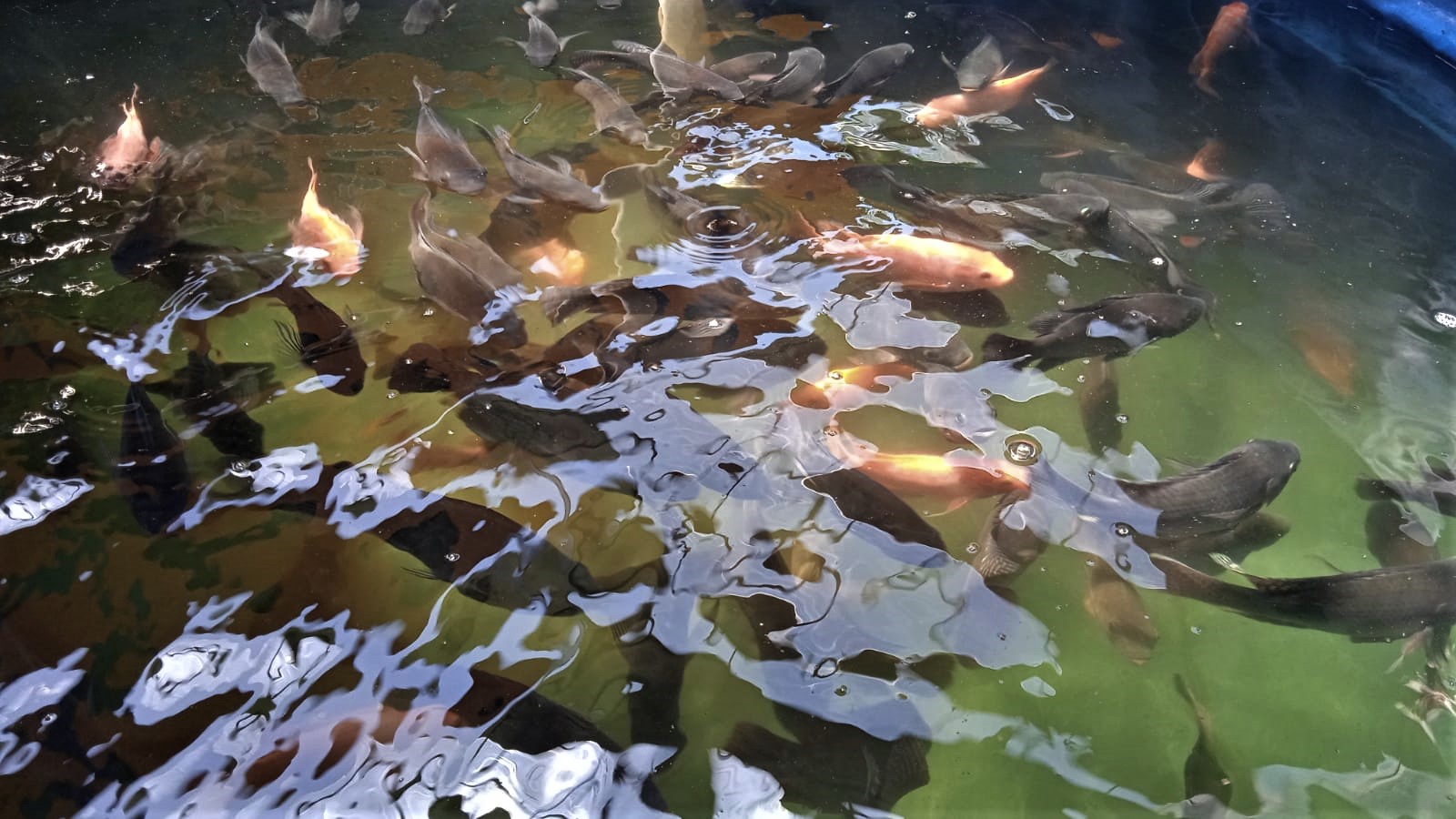
Feed is an important aspect in fish farming. Feed accounts for about 60% of the total production cost. Selection of quality feed affects the quality of fish cultured. Farmers need to be selective and observant in choosing the type of feed so that the results are as desired. Now, many fish feeds are mixed with subalan ingredients in order to reduce feed production costs. Subalan materials or counterfeit materials are ingredients that have no nutritional value but are added to feed. Forgery of feed aims to increase feed weight thereby reducing production costs. Now the number of fake feed causes unrest among consumers, one of which is fish or shrimp cultivators.
The main nutritional component in fish or shrimp feed is protein. Protein serves as the main source of energy so it is needed in large quantities. Things to consider when buying feed are availability and price. The limited availability of feed ingredients causes an increase in feed prices. The main ingredient for making pellets is fish meal, it can even exceed 30% of the composition. On the other hand, if the price of pellets made from fish meal is too cheap or below the standard price, it can indicate that the feed contains subalts.
Recognizing Subalan Materials
Subalan which is mixed in fish feed has characteristics similar to the original feed ingredients. Examples of subalan materials are sawdust, corn dregs, brick dust, even sand. These ingredients have in common, namely color, texture, and shape with real feed. For example, the color and texture of fish meal is similar to sawdust, which is yellowish brown in color and fine. One way to determine feed content is proximate analysis. Proximate analysis is testing feed to determine crude fiber content, moisture content, ash, total fat, protein, and carbohydrates.
However, it was recently discovered that proximate analysis is not accurate enough to test feed content. This is because the subalan material also has the same content as the original ingredient, but cannot be digested by the digestion of fish. For example, feather meal contains keratin which is difficult for fish to digest. Thus, other tests are needed to reduce losses due to feed adulteration.
Characteristics of Subalan Material
Some of the following simple tips consumers can do to avoid losses due to substandard feed.
- Color. Consumers must be observant with the difference in feed color. For example, the color of fish meal tends to be pale yellow. In contrast to sawdust has a darker and duller color.
- Texture. The original feed texture tends to be smoother. For example, fish meal has a finer texture than sawdust. Testing the texture of the feed can be done using a fine sieve. Original feed tends to pass through a fine sieve.
- Smell. The original feed smell is of course distinctive. For example, fish meal has a distinct fishy smell, corn flour smells like corn, and soy flour smells like soybeans. Meanwhile, subalan materials such as sawdust do not have a distinctive pungent odor.
- Using tools (loop and microscope). loop and a microscope can help identify feed ingredients more accurately. Feed can be seen in great detail and up close so as to know the original shape of the material.
- The price is too cheap. Fake materials certainly have a cheaper price. If the feed to be purchased has a very cheap price with a high weight, it should be suspected that it contains subalan ingredients.

Photo: Taqiy
Test of feed ingredients that have become pellets
This can only be tested by proximate analysis even though the results are less accurate. In addition, consumers must be careful whether feed prices are too cheap or not. Consumers can perform self-tests such as breaking speed in water, fish attractiveness, and buoyancy. Testing of feed ingredients is important so that the quality of the feed is maintained. Real feed takes longer to break down in water as it maintains its integrity. The allure of fish can be seen from their appetite when stocking. Floating feed will usually float longer in the water than sinking feed.
Adverse Impact of Subalan Material on Fish Growth
Usually the impact of subalan will be known within a certain period of time. Some of the effects of subalan ingredients on fish are as follows.
- Pool water is easily cloudy. Feed additives are very easy to contaminate water. Even some materials such as sand cannot be decomposed and instead damage the pond ecosystem, such as probiotic bacterial microorganisms.
- Slow fish growth. The nutritional value is reduced due to the lack of feed nutrients. Subalan materials such as brick dust, sand, and sawdust certainly have no nutritional value. Fake feed ingredients will accumulate and damage the fish's digestive organs if given continuously.
- Vulnerable to disease. Subalan materials will damage the digestive system of fish and immunity. It is not clear where the subalan material comes from and how it is processed. Subalan materials can be contaminated by bacteria or disease-causing microorganisms that can infect fish.
Make your own feed using alternative flours and ingredients
The high price of commercial feed and the large amount of subalerts it contains make cultivators have to be very careful. Many farmers actually make fish pellets independently in order to maintain the quality and safety of the feed. In addition, the costs incurred tend to be less than buying commercial pellets.
Formulation of feed ingredients can adjust the needs. This adjusts the needs of the fish. If fish are experiencing slow growth, then the dose of protein protein can be increased. For example, if you need 27% protein, you can use the following formulation. The materials needed are fish meal (10%), tapioca flour (7%), soybean flour (15%), meat meal (10%), wheat flour (15%), corn dregs (13%), corn flour (15%). %), and CGM (15%)

Photo: Taqiy
Cultivators can first smooth the feed used using a sieve. Then weigh the ingredients that have been refined according to the percentage of formula and needs. Stir all the ingredients starting from the smallest amount into the basin. Stir gently while adding water as much as 1/4 of the total amount, then heat by steaming. The semi-finished fish feed is then formed into balls when it is hot. Drop a little fish oil when printed so that the pellets break down and don't clot. Finally, dry the pellets until they are completely dry.

Photos: rumahmachine.com
Apart from flours, several alternative ingredients in the following pellets are also effective in increasing fish growth.
- Fish offal. Fish offal is a fishery waste that can be used as a pellet base. Fish offal contains high protein and unsaturated fat. Processing must be boiled and baked until completely dry.
- Fish meat. Fish meat, one of which is lemuru, is a high source of protein. The processing is similar to offal, namely by boiling and baking until the water content is completely gone.
- Moringa leaves. Moringa leaves contain vitamins and as a source of forage. How to process it by separating the Moringa leaves from the stems and boiling it until the water boils. Moringa leaves are baked until there is no water content.
- Durian seeds. The carbohydrate content of durian seeds serves as a source of energy. Durian seeds are boiled until soft and then baked in the oven until the water content is gone.
- Cabbage waste. Cabbage waste serves as a source of fiber which facilitates the digestion of fish. Cabbage is chopped and boiled until soft. Bake the cabbage until the water content is gone.
- Mustard waste. Mustard waste also serves as a source of fiber. Mustard waste is boiled until soft and then baked in the oven until completely dry.
Feed quality will affect fish growth. The better the quality of the feed, the faster the growth of fish. Feeding ratio / Feed Conversion Ratio (FCR) also needs to be considered so that it is not excessive or lacking in feed management. FCR is the amount of feed needed to produce 1 kg of meat. Determining FCR must consider the amount of biomass, Feeding Rate (FR), and Survival Rate (SR). Efficient feeding certainly saves feed costs. Feed contributes around 70% of cultivation costs, so cultivators must be careful in choosing feed and the amount of feed given is efficient.
Reference:
Eilien. (2019, August 13). Easy Home Fish Feed Business and its Opportunities. Taken Back from https://danadesa.id/usaha-pakan-ikan-rumahan/
Mangelep, C., Wolayan, FR, Imbar, MR, and Untu, IM 2016. Partial Feed Replacement with Chicory Waste Flour (Brassica pekinensis l) Against Broiler Performance. ZOOTEC, 37(1), 8-14.
Nurhayati, T., and Desniar, SM 2013. Making Peptone Enzymatically Using Raw Materials of Tuna Offal. Journal of Processing of Indonesian Fishery Products, 16(1), 1-11.
Widarti, BN, Wardhini, WK, and Sarwono, E. 2015. Effect of C/N Ratio of Raw Materials on Making Compost from Cabbage and Banana Peels. Journal of Process Integration, 5(2).
Author: Ijl Taqiy Christya Dewanta (SIKIA Aquaculture Student)
Editor: Avicenna C. Nisa