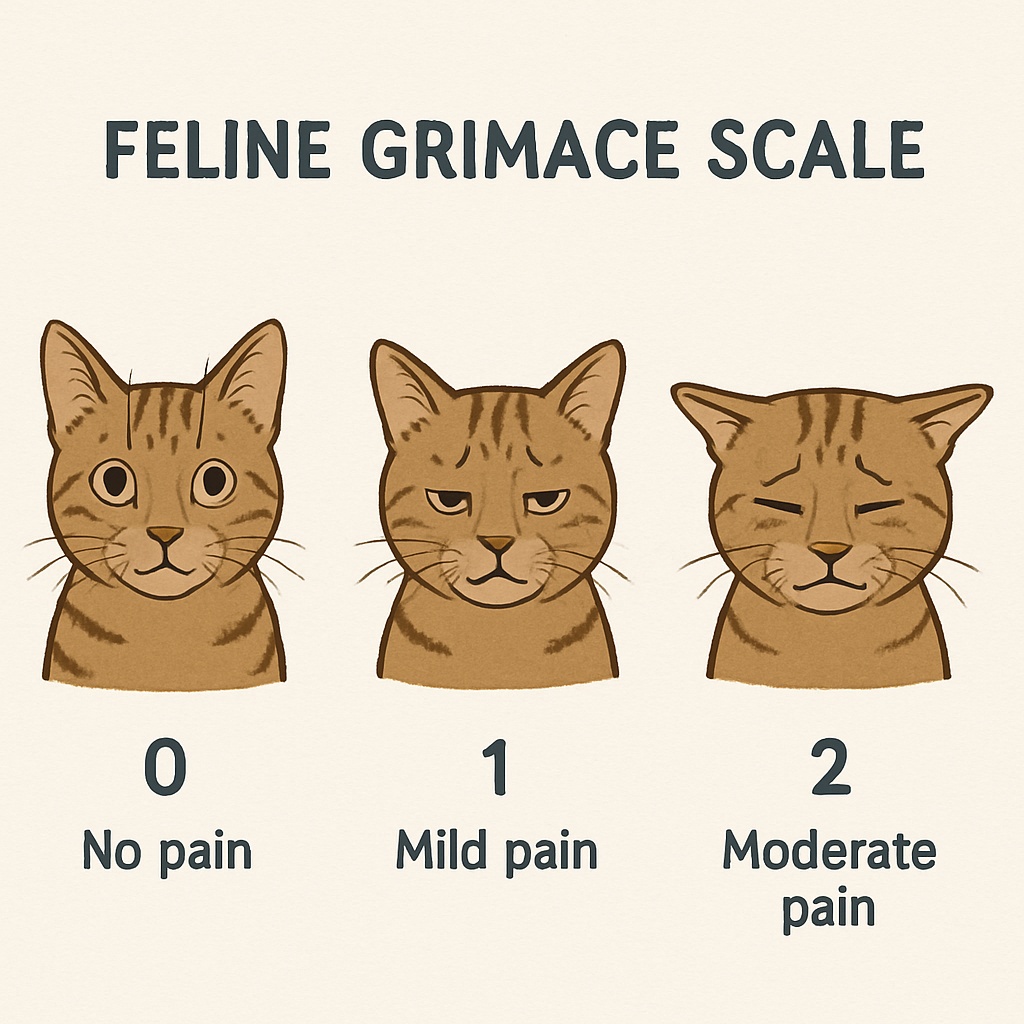
Cats are known for their excellent ability to hide pain. Pain is a subjective and multidimensional experience that can vary greatly between individuals. Pain in animals can be acute, chronic, intense, or even intermittent. It's crucial for every pet owner to be able to detect pain associated with a specific illness so they can take their pet to the veterinarian as soon as possible.
In veterinary medicine, pain assessment requires consideration of a combination of clinical measurements and observations. For example, activity level, body posture, weight loss, decreased body condition, and ability to perform self-care (grooming), changes in food and water intake, feces and urine output, hydration levels, body temperature, and pulse or respiratory rate.
Changes are also seen in response to touch (vocalization, abnormal aggression, lameness), teeth grinding, photophobia, vomiting and diarrhea, self-inflicted trauma (self-inflicted trauma), or organ failure as indicated by imaging or laboratory results (Goldberg, 2018).
Assessment Based on Facial Morphometrics
Changes in facial expression are one observable clue to recognizing this condition. Understanding the signs of pain in cats is crucial for raising awareness of animal health and welfare. One method that can be used to help recognize acute pain in cats is Feline Grimace Scale (Burns, 2019). The relationship between the neurobiology of pain and facial expression.
Noxious stimuli are transduced through free nerve endings. Nociceptive signals are transmitted by peripheral nerve fibers and are modulated and projected from the dorsal horn of the spinal cord to various regions of the central nervous system. After reaching cerebral structures such as the thalamus, their connections to the amygdala and...
As a result, the motor cortex initiates an efferent motor response to pain. The motor cortex is directly connected to the facial nucleus in the pons and to cranial nerve VII, which innervates the facial muscles. Activating these regions results in the production of facial muscle movements that produce facial expressions that can be associated with the perception of pain (Mota-Rojas et al. 2025).
Feline Grimace Scale (FGS) can be an assessment tool that uses changes in facial expressions as an indicator of pain in cats. This method can help veterinary professionals and owners become more sensitive to subtle changes that occur when a cat is experiencing pain, which can lead to pain symptoms. FGS assesses five facial action units from changes in the characteristics of a cat's face related to pain, namely ear position, narrowing of the eye area, tension in the muzzle, changes in whisker position, and head position (Chiavaccini et al. 2024).
FirstEar position. A comfortable cat generally has its ears in a normal, relatively upright position. When experiencing pain, the ears may shift to a more sideways or flat position.
Secondly,Orbital tightening, or narrowing of the eye area. A cat's eyes may appear narrower than normal. This change is one of the signs to look for when observing a cat's expression.
Third, tension in the muzzle. A muzzle that normally appears relaxed can appear more tense when a cat is experiencing pain.
Fourth, whisker position changes. A cat's whiskers can change position when they experience pain. They may appear straighter and recede from the face than normal.
FifthHead position. Cats experiencing pain may hold their heads in a lower position than usual. This change can be seen along with other changes in facial expression (Steagall and Monteiro, 2019).
Scoring Feline Grimace Scale

These five indicators should not be observed in isolation. Changes in expression should be compared to the cat's normal condition and observed when the cat is relatively calm (AVSAB, 2023). Evangelista et al. (2019) explained that assessment is based on ear position, narrowing of the area around the eyes, muzzle tension, whisker position, and head position. A score of 0 indicates no pain, 1 indicates moderate or uncertain signs, and 2 indicates clear signs. A score of 4 or more indicates the cat is experiencing pain and requires analgesic administration. The maximum total score is 10. Therefore, identifying facial changes in cats with pain is crucial.
Recognizing pain in cats is an essential part of responsible pet ownership. Seemingly simple facial expressions can provide important information about the animal's condition. If your cat exhibits unusual behavioral changes, appears to be in pain, refuses to eat, has difficulty moving, has an injury, or exhibits facial expressions suggestive of pain, it's best to consult a veterinarian immediately. Furthermore, cats who have recently undergone surgery or have certain medical conditions require regular pain monitoring. Do not give your cat human pain relievers without a veterinarian's recommendation, as some medications that are safe for humans can be dangerous or even fatal for cats. The sooner pain is recognized, the sooner your cat can receive appropriate treatment.
Author: Azhar Burhanuddin (Student of Wave III of Veterinary Professional Education FIKKIA UNAIR)
Reference:
American Veterinary Society of Animal Behavior. (2023, November 11). The Feline Grimace Scale helps you know if your cat is in pain. https://avsab.org/the-feline-grimace-scale-helps-you-know-if-your-cat-is-in-pain/. Accessed on August 10, 2026
Burns, K. (2019). New scale interprets pain from feline facial expressions. JAVMA News. https://www.avma.org/javma-news/2019-10-01/new-scale-interprets-pain-feline-facial-expressions. Accessed on August 10, 2026
Chiavaccini, L., Gupta, A., & Chiavaccini, G. (2024). From facial expressions to algorithms: A narrative review of animal pain recognition technologies. Frontiers in Veterinary Science, 11, 1436795. https://doi.org/10.3389/fvets.2024.1436795
Evangelista, M.C., Watanabe, R., Leung, VSY, Monteiro, B.P., O'Toole, E., Pang, DSJ, & Steagall, P.V. (2019). Facial expressions of pain in cats: The development and validation of a Feline Grimace Scale. Scientific Reports, 9, 19128. https://doi.org/10.1038/s41598-019-55693-8
Goldberg, M.E. (2018). Pain scoring systems for cats. Feline Focus, 4(1), 15-21.
Monteiro, B. P., Lee, N. H., & Steagall, P. V. (2023). Can cat caregivers reliably assess acute pain in cats using the Feline Grimace Scale? A large global bilingual survey. Journal of Feline Medicine and Surgery, 25(1), 1-9. https://doi.org/10.1177/1098612X221145499
Mota-Rojas, D., Whittaker, A.L., Coria-Avila, G.A., Martínez-Burnes, J., Mora-Medina, P., Domínguez-Oliva, A., Hernández-Avalos, I., Olmos-Hernández, A., Verduzco-Mendoza, A., Casas-Alvarado, A., & Grandin, T. (2025). How facial expressions reveal acute pain in domestic animals with facial pain scales as a diagnostic tool. Frontiers in Veterinary Science, 12, 1546719. https://doi.org/10.3389/fvets.2025.1546719
Steagall, P. V., & Monteiro, B. P. (2019). Acute pain in cats: Recent advances in clinical assessment. Journal of Feline Medicine and Surgery, 21(1), 25-34. https://doi.org/10.1177/1098612X18808103
WSAVA. (2020). New tool for acute pain assessment in cats developed by WSAVA Global Pain Council Member. URL: https://wsava.org/updates/new-tool-for-acute-pain-assessment-in-cats-developed-by-wsava-global-pain-council-member/. Accessed on August 10, 2026