

PUBLIC HEALTH STUDY PROGRAM
Study Program Profile
The Public Health Study Program is driven by the effort to build healthy and self-sufficient communities. Health remains a national priority, requiring the development of adaptive human resource skills and scientific knowledge.
EDUCATION
Study Period and Accreditation
Educational level and accreditation status of study program.
- Institution
- Indonesian Independent Accreditation Institute for Higher Education in Health (LAM-PTKes)
- Validity period
- 2023 to 2028
- Certificate number
- 0153/LAM-PTKes/Akr/Sar/II/2023
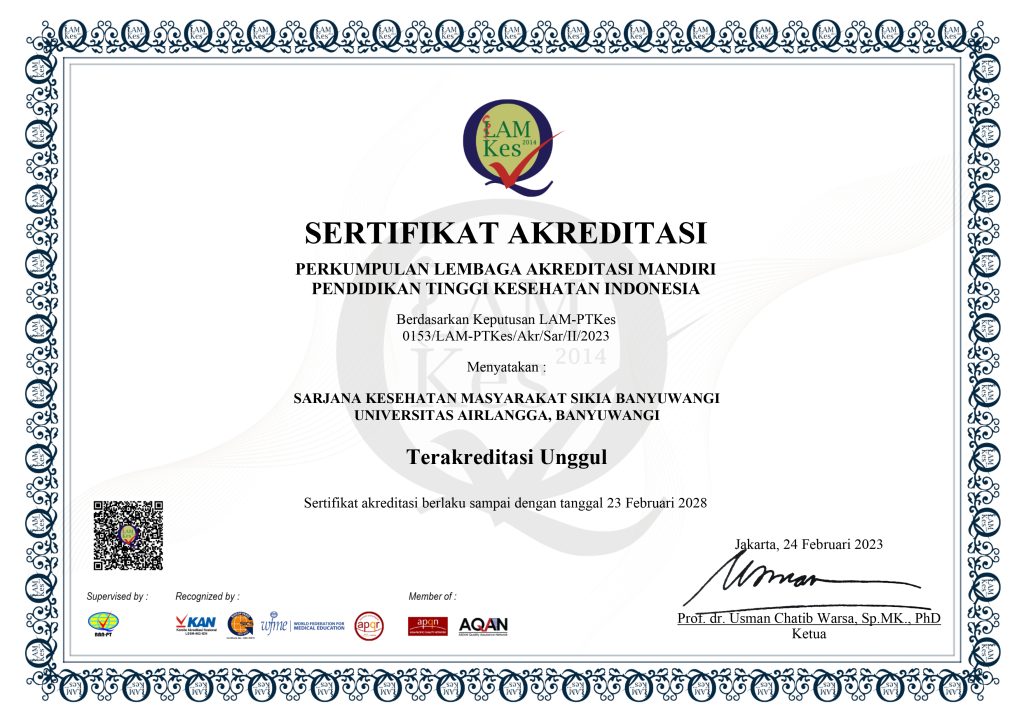 View certificate
VISION, MISSION, AND OBJECTIVES
Direction and Aims of the Study Program
The foundation that guides education, research, and service in the Public Health Study Program.
Becoming a leading Public Health Study Program that produces graduates who are proactive, innovative and professional in the field of public health who have an impact on society at the local, regional, national and international levels based on religious morality.
- 1
Organizing academic education based on modern learning technology based on religious morals.
- 2
Implementing quality education based on evidence-based learning processes, student-centered learning, problem-based learning, and the 3L concepts (data literacy, technological literacy, human literacy) and 6C (computational thinking, critical thinking, communication, collaboration, creativity, compassion).
- 3
Carry out research and publish it in scientific journals at local, regional, national and international levels.
- 4
Carry out research-based community service programs in the field of public health to help solve public health problems at the local, regional, national and international levels in order to support the achievement of SDG's (Sustainable Development Goals).
- 5
Build partnerships and networks with alumni, industry, academic institutions, government and professional organizations at local, regional, national and international levels.
- 1
To produce quality graduates in the academic field in Public Health who are able to contribute actively to problem solving public health issues.
- 2
To produce quality graduates in the academic field in Public Health who are able to generate innovative ideas and implement them professionally in their fields.
- 3
Producing graduates who are able to:
- Applying public health science with a promotive and preventive approach as well as skilled leadership and thinking in the context of systems with effective communication skills.
- Manage health organizations and systems.
- Carry out policy analysis in the health sector.
- Doing community empowerment and developing social support, networking, accessibility.
- Assessing health status based on data, information and health indicators for decision making.
- 4
Carrying out the learning process effectively, efficiently, sustainably and with competitiveness in a conducive academic atmosphere.
- 5
Carry out education that is sensitive to the needs of the labor market and pays attention to access and equity.
- 6
Providing resources that are able to keep up with the development of knowledge and technology in the field of public health.
- 7
Produce research that supports the development of science and technology by lecturers and students.
- 8
Disseminate research results in the form of publications in scientific journals at local, national and international levels.
- 9
Implementing research results in the form of community service at the local, regional, national and international levels in order to support the achievement of the SDGs (Sustainable Development Goals).
- 10
Establishing cooperation and partnerships with alumni, industry, academic institutions, government and professional organizations at local, regional, national and international levels.
STUDY PROGRAM DETAILS
Advantages and Support
Interest programs, practice facilities, and support for students.
There are 8 interest programs available, including:
Supported by adequate practice facilities and local, national and international cooperation partner areas.
Has outbound and MBKM (Independent Learning Independent Campus) programs.
Has learning support facilities such as integrated laboratories and reading rooms.
Various kinds of full and partial scholarships.
PROSPECTS
Graduate Careers
Fields of work that can be pursued by graduates of the study program.
Graduates who have completed the Public Health Bachelor's Degree Study Program are expected to have careers as:
ACADEMIC
Courses and Curriculum
Download course documents and study program curriculum.

Useful Links
SMART CENTER
Contact Us
kontak@fikkia.unair.ac.id
+ 62 811-3086-247
Mojo Campus: Jalan Attorney General Suprapto 142 Mojopanggung, Banyuwangi, 68425.
Giri Campus: Jl. Wijaya Kusuma No. 113, District. Giri, Banyuwangi Regency, 68425. Tel: 0333 - 417788, Fax: 0333 - 428890
Sobo Campus : Jl. Wijinongko Fish No. 18a, Sobo, Kec. Banyuwangi, Banyuwangi Regency, 68418
Copyright 2026 All Rights Reserved.
