


FIKKIA NEWS – Students majoring in Health Promotion and Behavioral Sciences (PKIP) Public Health Study Program FIKKIA Airlangga University had the opportunity to deepen their knowledge through a guest lecture entitled "Implementation of Health Promotion in Indonesia." The guest lecture was held on Saturday, February 28, 2026, via Zoom.
This activity presents resource persons, Theresia Rhabina Noviandri Purba, SKM, M.KM Head of the Health Promotion Working Team at Health Service Facilities Ministry of HealthThe guest lecture was attended by 80 students from various classes, including FIKKIA and FKM UNAIR students. Their enthusiasm was evident through their active participation during the presentation and discussion sessions.
National Health Challenges Across the Life Cycle
In their presentation, the speakers explained that Indonesia still faces a complex health burden across nearly all age groups. The 2021 Global Burden of Disease data shows that non-communicable diseases such as cardiovascular disease, diabetes, mental disorders, and chronic respiratory diseases are major contributors to the burden of morbidity and mortality. However, at the same time, nutritional issues and infectious diseases remain challenges for infants, toddlers, and adolescents.
"The burden of our health problems extends across the life cycle. On the one hand, non-communicable diseases continue to rise, while on the other, the problems of nutrition and infectious diseases have not been fully resolved," he explained.
Based on the 2023 Indonesian Health Survey (SKI), the prevalence of stunting in toddlers reached 21,5 percent. Anemia in adolescents was recorded at 15,6 percent, while mental health problems in school children and adolescents reached 34,9 percent. Among adults, awareness of non-communicable disease screening remains low, with only 39,8 percent of the population having been tested.
This situation demonstrates that health issues cannot be resolved through curative approaches alone. Strong promotive and preventive strategies are needed, particularly in controlling risk factors such as smoking, an unbalanced diet, physical inactivity, and metabolic disorders like hypertension and high blood sugar levels.
Behavior Change-Based Health Promotion Implementation Strategy
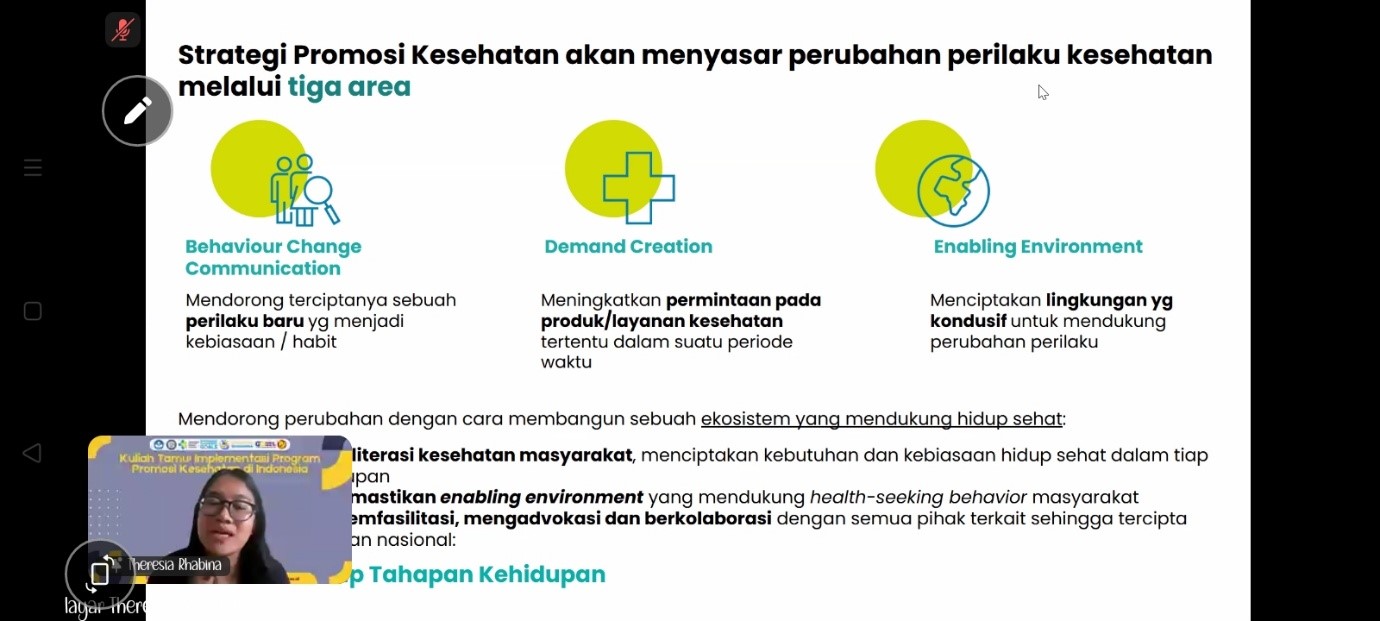
Health promotion strategies are now directed at changing health behavior through three measurable and sustainable areas.
The approaches used include behavior change communication, creating an enabling environment, and campaigns based on data and target characteristics. Several programs are being implemented, including the Healthy Pregnant Women Movement, the Nutrition Action Movement for Teenagers, the ABCDE Campaign to Prevent Stunting, and the #Promise to a Healthy Life campaign.

Furthermore, the capacity of Posyandu (Integrated Health Post) cadres is being strengthened through the development of 25 basic health skills, ranging from nutrition education and monitoring child growth and development to screening for non-communicable diseases. Through cross-sector collaboration and central-regional synergy, health promotion is expected to foster a healthier, more productive, and more competitive generation in the future.
In closing, the Head of the Health Promotion Working Team at Health Service Facilities emphasized that health promotion is not only limited to outreach activities or information delivery, but also in encouraging changes in health behavior.
"Health promotion isn't just about education. We encourage healthier behavior changes, using a lifecycle approach and considering various social, economic, commercial, and environmental factors," he emphasized.
Author: Annisa Dwi Cahyani
Editor: Avicenna C. Nisa