


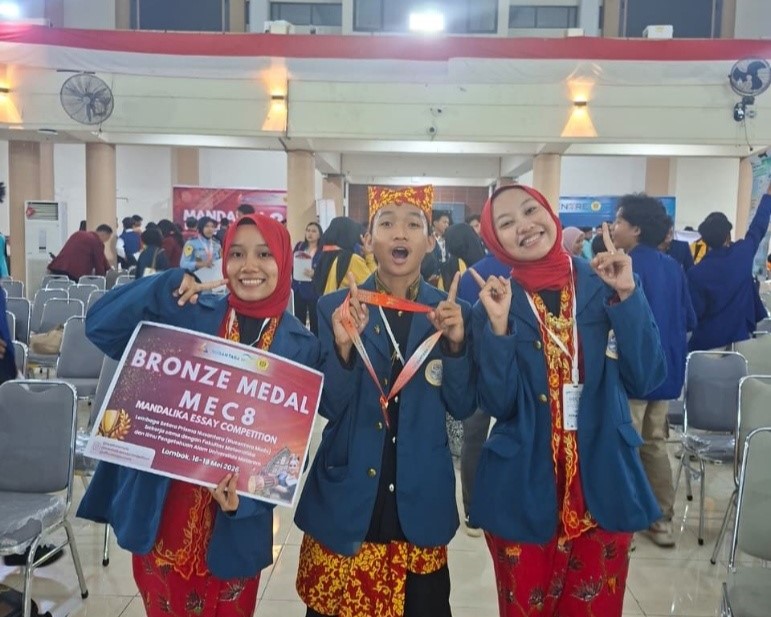
FIKKIA NEWS – Students of the Faculty of Health, Medicine, and Natural Sciences (FIKKIA) of Airlangga University have once again achieved national success. The “Gas Melomba” team won a bronze medal in the Mandalika Essay Competition (MEC) 8. The competition took place on May 16–18, 2026. The team consisted of Andhika Juliandra Saputra (KU 2025), Revalina Putri Azzahra (KESMAS 2025), and Nur Fitri Jum'Ati (AKUA 2025). The competition was organized by the Nusantara Muda Institute in collaboration with the Faculty of Mathematics and Natural Sciences of the University of Mataram. The activity also received support from the Entrepreneurship Factory for Youth Community (ENTRE).
In the final round, the Gas Melomba team competed against 22 other finalists from various universities across Indonesia. Under the guidance of Dr. Kurnia Alisaputri, Sp.PD., FINASIM., they submitted an essay entitled "CULTURAL CORNER."
The essay stands for "Seduluran Peduli Lingkungan Sehat Berbasis Budaya" (Culture-Based Healthy Environmental Care). The initiative focuses on developing eco-cultural health villages as disaster mitigation and sustainability measures in the Kampungmandar Village area. This coastal area is popularly known as plengsengan.
The team chose North Pelengsengan Beach as the location for developing a health and education-based tourism village.
They believe the coastal area has great potential, but it hasn't been optimally managed. The main problems are environmental cleanliness and public health.
Adopting a One Health Approach
The Gas Melomba team developed the tourism village concept using the One Health approach. This approach integrates the fields of medicine, public health, and aquaculture.
The aquaculture sector focuses on water quality monitoring using monitoring cages. The team also highlighted grouper as a superior local product. Grouper was chosen based on its abundant availability in the Bali Strait.
Meanwhile, the medical field plays a role in educating people about seawater-related diseases. The team also initiated basic health checks for coastal communities.
In the public health sector, they introduced environmentally friendly MSME innovations. These innovations utilize waste to create porous paving blocks and photocatalytic lamps to help reduce air pollution.
Paving blocks are made from a mixture of plastic, sand, and used oil. Their hollow structure helps absorb rainwater more quickly. This product also helps reduce standing water, which can breed mosquito larvae.
Meanwhile, photocatalytic lamps are made using a titanium dioxide coating that uses sunlight to convert pollutants into environmentally friendly compounds. To ensure safety during use, the titanium dioxide is coated with a resin to prevent degradation that is harmful to the lungs.
Initiate an Environmentally Caring Community
The Gas Melomba team also initiated the "One Hand, Thousand Dreams" community. This community encourages the public to clean up trash in coastal areas. Volunteers will process plastic waste into eco-friendly paving blocks. This initiative supports sustainable waste management in coastal areas.
The team's innovation aligns with the Sustainable Development Goals (SDGs). This initiative supports SDGs 3, SDGs 6, SDGs 11, and SDGs 14.
The program also supports the implementation of the government's Asta Cita (Planning for National Development), focusing on health, village development, and community welfare based on local potential.
Author: Cantika Anggun Roudhotul Al Zahra
Editor: Avicenna C. Nisa


