


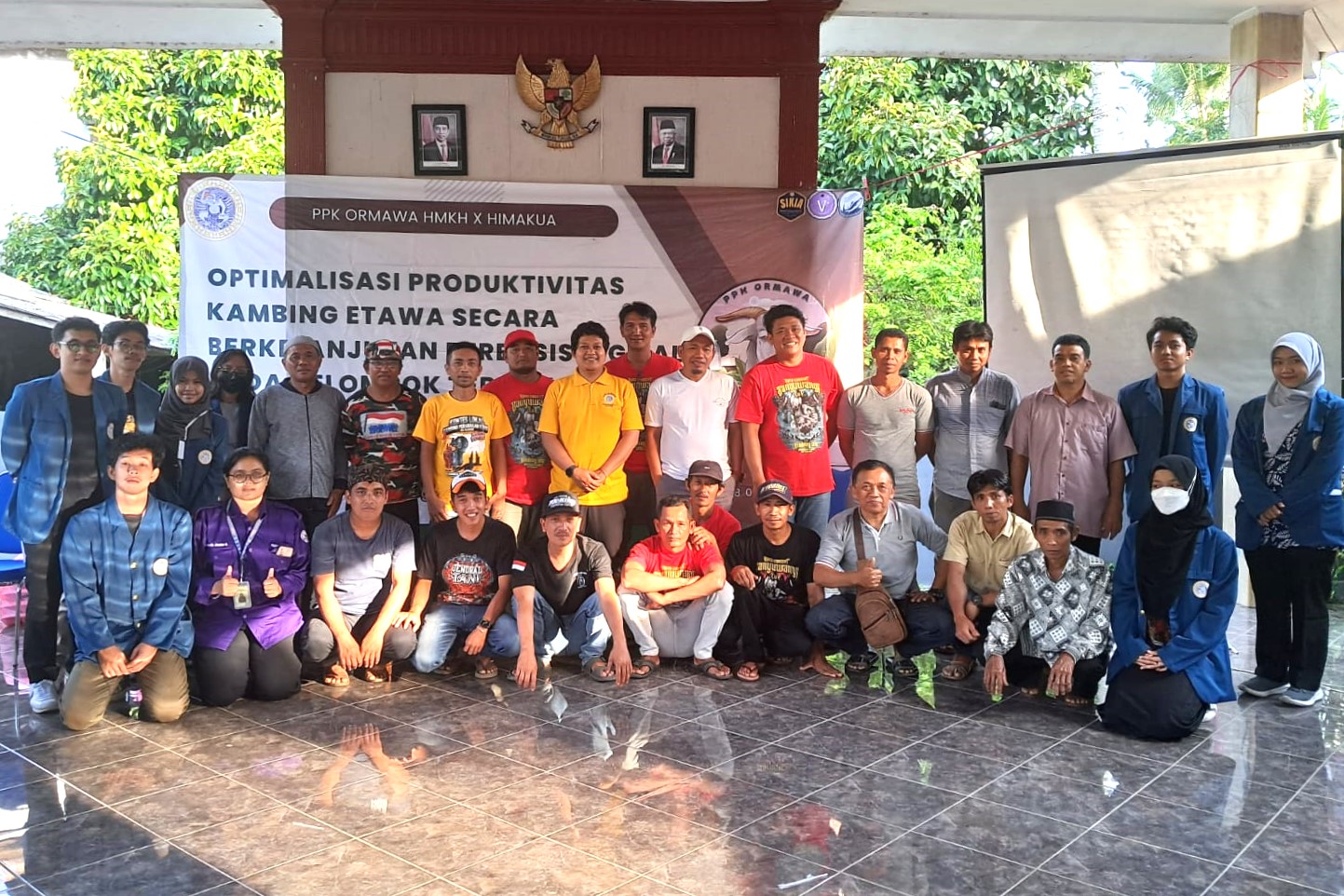
SIKIA NEWS – Capacity Building Program Team for Ormawa, Veterinary Medicine Student Association (HMKH) and Aquaculture Student Association (HIMAKUA) School of Health and Natural Sciences (SIKIA) Airlangga University continues to improve the health of goats in the Telemung Village area, Kalipuro District, Banyuwangi Regency. This was realized in the implementation of "Goat Care Management Socialization." The socialization was held on Saturday (30/9/2023) at the Telemung Village Hall at 14.00 WIB.
Lecturer at the SIKIA Veterinary Medicine Study Program, Amung Logam Saputro, drh., M.Sc. present as a speaker by providing this counseling. This activity succeeded in targeting 25 local communities. The topic of the counseling given is health management and maintenance of goats for mothers and young (cempe). So that through outreach, the community can pay more attention to the management of goats of all ages.
Breeding the Heart of Livestock
Breeding is an important pillar in the livestock business in producing superior seedlings that meet standards. The production of large, quality and healthy seeds is an indicator of increasing the economic circulation of breeders in terms of productivity. Quality cempe genetics can be seen from the condition of the parent. The results of offspring production depend on the genetics of the male and female parent being mated. The selection of breeder quality is not based on age, but on body weight. New heifers may be bred when their body weight has reached 60 to 70 percent of their adult weight. For example, if the body weight of an adult female can reach 50 kg, then heifers may be bred when their weight reaches a minimum of 30 kg.
Mothers Must Match Their Pregnancy Time
The important thing that breeders must master is knowing reproductive conditions such as signs of lust, lust cycle, signs of pregnancy, timing of pregnancy. From a health perspective, farmers must also regularly check the condition of the goats with a veterinarian to ensure there are no infections and ensure a normal birth process.
Before mating, breeders must also ensure that the female is able to support pregnancy, produces good milk, and is able to maintain her shrike.
Breeders must ensure optimal calving spacing is only 3x in 2 years. Apart from that, postnatal marriage may only be carried out after uterine involution The maximum is 45 days after birth. This is to ensure that cempe's nutritional needs are met optimally.
At maturity, the parent can support the life of the new individual. If the parent is not ready, mark it with a condition baby blues where the doro mother will leave her champe after giving birth because her maternal characteristics have not yet emerged. Cempe will be born small with a low weight. The mother's breast milk does not contain colostrum which is sufficient for the initial growth needs of the shrike.
High Mortality
8 weeks of life is a crucial age with a high risk of death. At this age, cempe need colostrum contained in breast milk to build the body's immune system. Good colostrum is characterized by thick viscosity with a golden yellow color. Therefore, farmers must recognize the condition of the milk produced to remain aware of declining colostrum quality, such as in cases of mastitis. Colostrum will only be produced 3-5 days after giving birth. The older the cempe are, the cempe cannot absorb the colostrum content with a volume of 10% of body weight. You also need to pay attention to the condition of your body fluids by providing tube feeding if you don't want to drink and using a catheter if you detect difficulty urinating.
PPK Ormawa HMKH x HIMAKUA activities will then carry out further counseling in the future. The material prepared is the technique of processing goat's milk, which is a superior product from the goat livestock of Telemung Village.
Author: Azhar Burhanuddin
Editor: Avicenna C. Nisa


